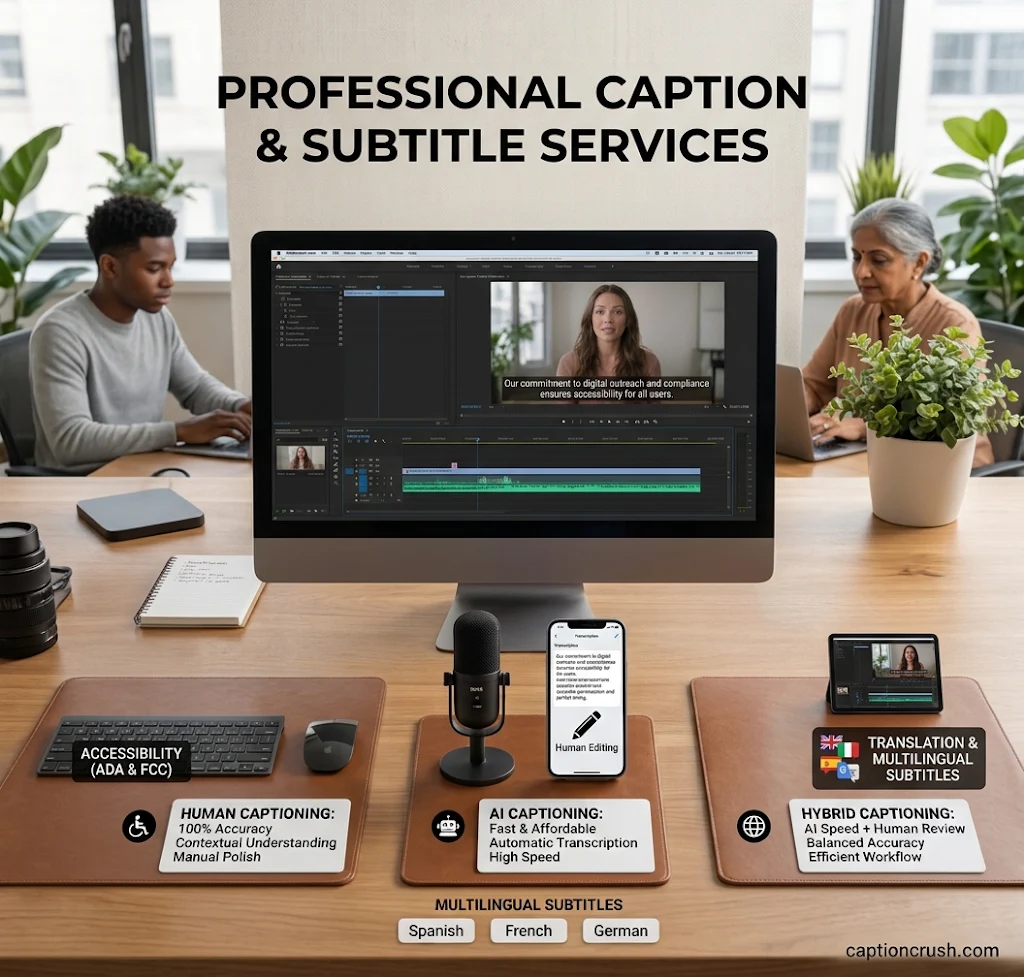
Caption and subtitle services turn spoken words into timed text on screen. Experts handle the transcription, timing, and file delivery for you.
This guide covers the types of video captioning services, US rules, costs, accuracy, and how to pick the right provider.
Table of Contents
What Are Caption and Subtitle Services?
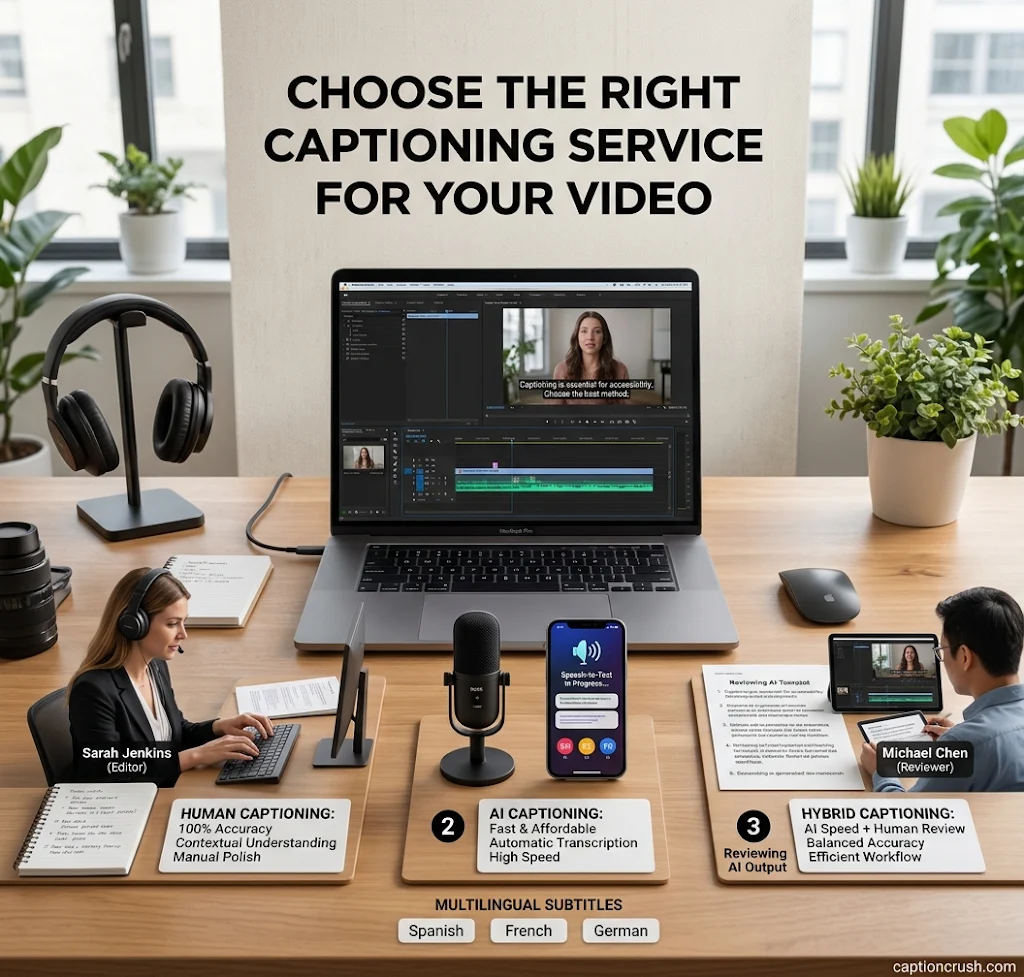
These services add timed text to your video so more people can follow it. Here is what they do and how captions differ from subtitles.
Caption and subtitle services transcribe the audio in a video, sync the text to the speech, and deliver it in the right file format. Many providers also offer translation and media services for TV, web, and DVD.
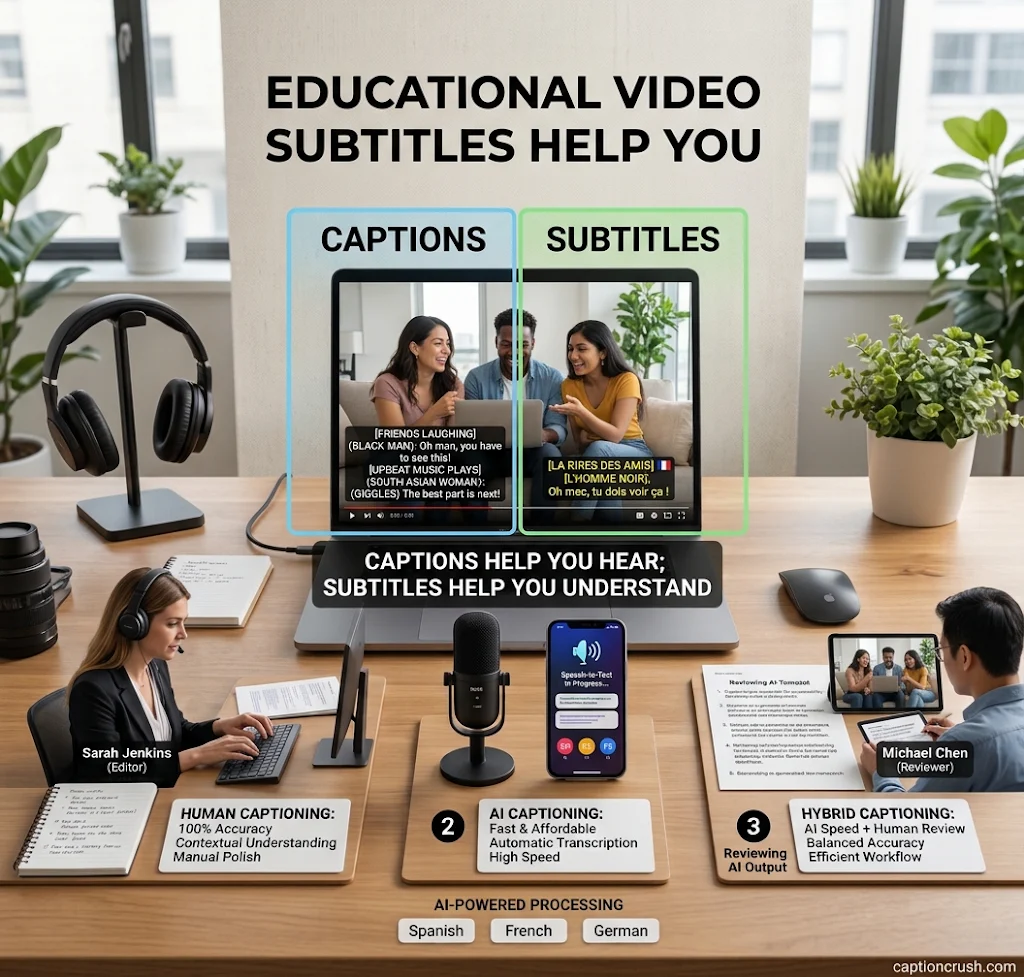
Captions and subtitles are not the same thing. The table below shows the gap.
| Captions | Subtitles | |
|---|---|---|
| Main goal | Help viewers who can’t hear the audio | Help viewers who can’t understand the language |
| What they show | Dialogue, speaker labels, sound effects, music cues | Dialogue only, often translated |
| Best for | Deaf and hard of hearing viewers, sound-off viewing | Multilingual audiences |
This split is common in the US and Canada. The UK and many other countries use “subtitles” for both, according to Wikipedia.
You will also hear about closed captions and open captions. Closed captions stay hidden until the viewer turns them on. Open captions, also called hardcoded or burned-in captions, are part of the picture. Everyone sees them.
SDH means “subtitles for the deaf and hard of hearing.” It adds sound cues and speaker names to subtitle files. Many DVDs and streaming titles use it.
Once your video has the right captions and subtitles, the next step is creating engaging text that complements your visual content. If you’re sharing Bootstrap-themed designs on Instagram, explore these creative Bootstrap image captions to make your posts more appealing and engaging.
Types of Professional Caption and Subtitle Services
Not every video needs the same service. Here are the main types, plus the file formats you will meet.
Human, AI, and hybrid captioning are the three main options.
| Method | How it works | Best for |
|---|---|---|
| Human captioning | A trained captioner writes and checks every line | Legal, medical, broadcast, and ADA-sensitive content |
| AI captioning | Speech recognition creates the text in minutes | Social clips, tutorials, quick drafts |
| Hybrid captioning | AI drafts, a person fixes errors | Business videos, courses, webinars |
Live captioning and prerecorded captioning work differently. For live shows, a speech-to-text reporter types on a stenotype machine. These operators can reach up to 375 words per minute, and viewers see text within two to three seconds. Some broadcasters use respeaking. A trained person repeats the words clearly, and software turns them into text.
For prerecorded video, the team transcribes, positions, and times the text before release. This gives cleaner caption timing and better sync.
Translation and multilingual subtitles help you reach new markets. Tools like Kapwing and Captions.ai offer subtitles in more than 100 languages. In the US, the FCC also requires captions on TV programs with English or Spanish audio, with some exceptions.
File formats matter just as much. Pick the one your platform accepts:
- SRT and VTT: web video, social media, and most players
- SCC: broadcast and editing tools
- EIA-608 and CEA-708: US television
- TXT: plain transcripts
- Hardcoded export: short videos where text must always show
YouTube accepts SubRip (.SRT), SubViewer (.SUB), and .SBV files. Instagram, TikTok, and LinkedIn clips often use burned-in captions, since many people watch with the sound off.
Why Caption and Subtitle Services Matter in the USA
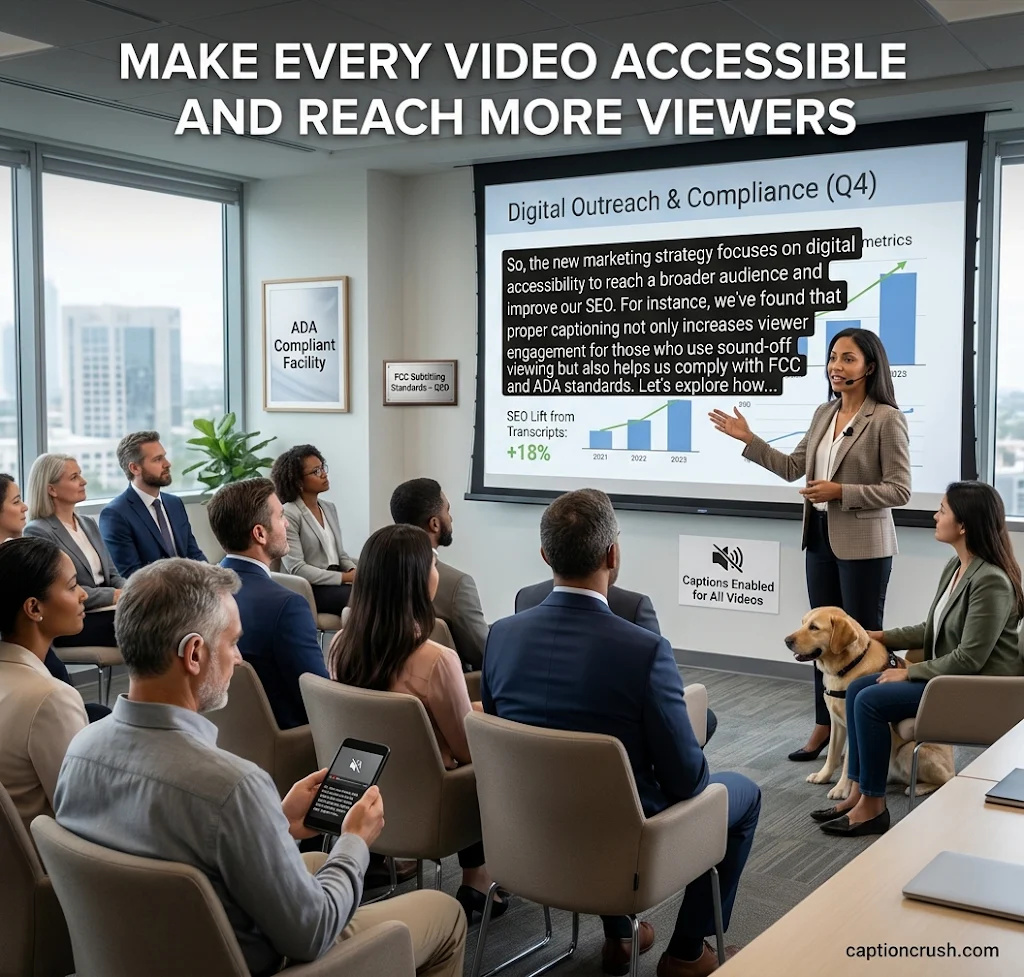
In the US, captions are about access, law, and reach. Here is why they matter and what the rules say.
Are captions required by law? For many cases, yes. The Television Decoder Circuitry Act of 1990 made caption decoders standard on larger TV sets. The ADA bans disability discrimination in public places. The 2010 Twenty-First Century Communications and Video Accessibility Act (CVAA) extended captioning to TV shows redistributed online.
The FCC also set quality standards in 2014. They cover accuracy, timing, completeness, and placement. Colleges and agencies often follow Section 508 and WCAG too. Rules differ by organization and content type, so check the latest deadlines for yours.
Who uses captions? More people than you may think.
- A 2016 Oregon State University study found that 70.8% of students with no hearing difficulty used captions at least some of the time.
- In the UK, 6 of 7.5 million TV subtitle users have no hearing loss.
Do captions help video SEO? Yes. An accurate transcript gives search engines text to index. Captions also keep sound-off viewers watching, which supports engagement and watch time.
Here is a quick checklist for US teams:
- Caption all public videos, webinars, and training content.
- Add speaker labels and sound effects.
- Keep text accurate, timed, and readable.
- Offer a downloadable transcript.
- Add Spanish subtitles for major US audiences.
How to Choose the Best Caption and Subtitle Services
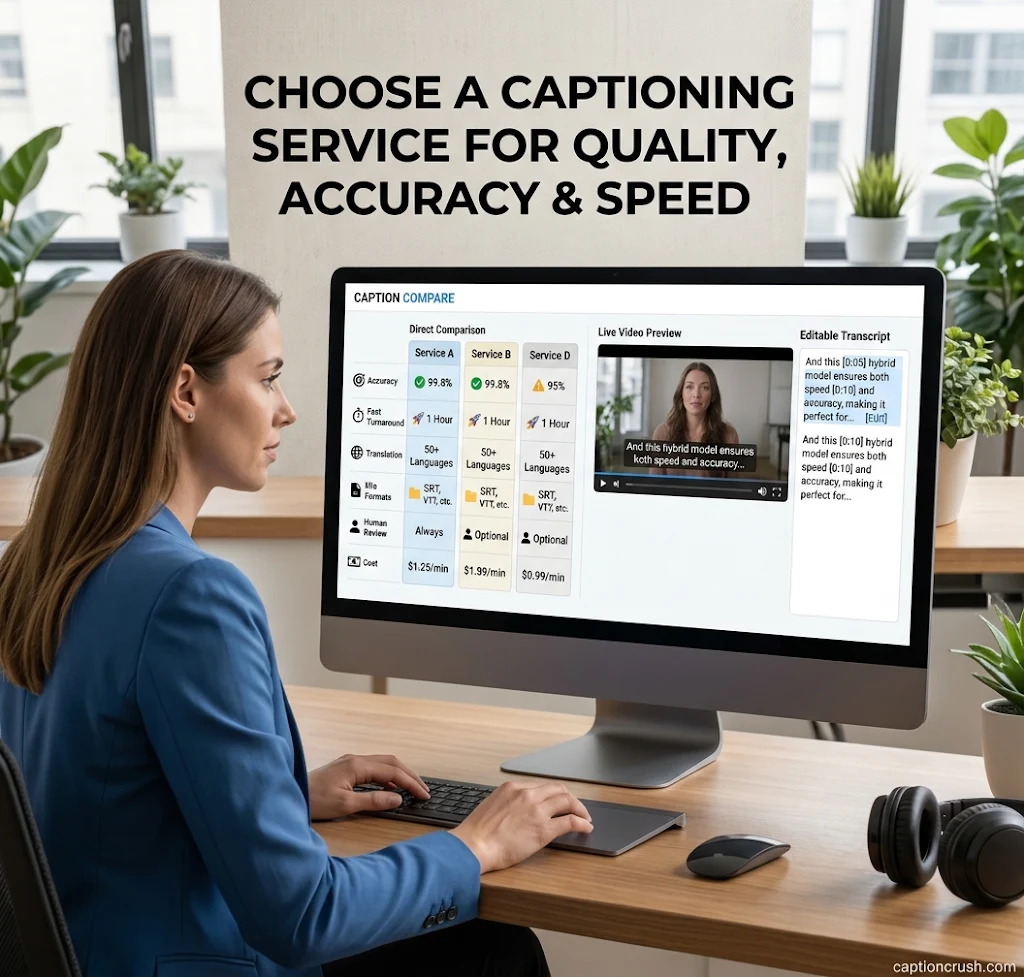
A good provider saves time and prevents costly fixes. Use these checks before you hire.
Check quality first. Look for high accuracy, tight sync, speaker identification, and an editable transcript. Good captions also stay short. Editors often target about 180 to 300 words per minute, depending on the program.
Compare turnaround time. Ask about standard and rush delivery. Longer videos and noisy audio take more time.
Know the cost factors. Price usually depends on:
- Video length
- Language and translation needs
- Audio quality and number of speakers
- Turnaround time
- Human review vs AI only
- File formats and media services
On Fiverr’s subtitles and captions category, listed prices typically run about $39 to $67, with an average near $54. Some services start at $5. Prices change, so always get a quote.
Know your provider types. Specialists like Capsub Services offer transcription, translation, and media services, including broadcast and DVD or Blu-ray files. Marketplaces like Fiverr connect you with freelancers. AI tools like Captions.ai, Kapwing, VEED, and Canva are fast and budget-friendly for social media videos.
Spot red flags. Walk away if a provider:
- Won’t share a sample
- Gives no accuracy promise
- Offers few file formats
- Skips a review step on sensitive content
FAQs
What are caption and subtitle services?
Caption and subtitle services turn the audio in a video into timed on-screen text. Providers handle transcription, timing, translation, and file delivery. Captions include dialogue and sound cues. Subtitles show dialogue, often translated. Businesses, schools, and creators use them for accessibility, compliance, and wider reach.
What is the difference between captions and subtitles?
Captions show dialogue plus sound effects, music cues, and speaker labels. They help deaf and hard of hearing viewers. Subtitles show dialogue only, often translated, for viewers who can hear but don’t know the language. In the US and Canada the terms differ. In the UK, “subtitles” covers both.
Why are caption and subtitle services important?
They make video accessible, help meet ADA and FCC rules, and reach more viewers. In a 2016 Oregon State survey, 70.8% of students with no hearing difficulty used captions at least sometimes. Captions also help sound-off viewing, and transcripts give search engines text to index.
How much do caption and subtitle services cost?
Cost depends on language, audio quality, speakers, and turnaround. On Fiverr, listed prices typically run about $39 to $67, with an average near $54. Some gigs start at $5. AI tools often use free tiers or subscriptions. Ask for a quote based on your video length.
How accurate are professional captioning services?
Many human-verified vendors aim for 99% or higher. AI tools vary. Kapwing says its AI subtitles reach 99% accuracy, but noisy audio, strong accents, and jargon can lower results. The FCC also sets TV caption standards for accuracy, timing, completeness, and placement. Always proofread before you publish.
Conclusion
Caption and subtitle services make your videos easier to watch, easier to find, and open to more people. They support accessibility, help you meet ADA and FCC rules, and keep sound-off viewers engaged. Start by picking the right mix of human and AI captioning. Then check accuracy, turnaround time, and file formats before you commit. Always proofread the final text. Do this, and your professional captioning and subtitling will build trust with every viewer.

Timmy Abroy is a content creator and the voice behind CaptionCrush, where he shares practical tips on social media captions, creator growth, and content strategy. When he’s not writing, he’s testing what actually gets people to stop scrolling.